


With 6,000 employees worldwide, KWS is a leading seed specialist operating in more than 70 countries. To manage the KWS brand consistently across international markets while actively involving all relevant teams, the company chose the wirHub brand management system. We spoke with Anke Hahlbrock, Expert Brand Management,Global Marketing and Communications at KWS, about the journey from a traditional asset management system, to KWS BrandNet–a dynamic brand platform.
![Anke_Hahlbrock_KWS[2999]](https://www.wirdesign.de/hs-fs/hubfs/Blogartikel/Anke_Hahlbrock_KWS%5B2999%5D.jpg?width=246&name=Anke_Hahlbrock_KWS%5B2999%5D.jpg) Anke Hahlbrock, Expert in Brand Management, KWS
Anke Hahlbrock, Expert in Brand Management, KWS
Ms. Hahlbrock, can you tell us a bit about the evolution of brand management at KWS?
As an international plant breeding company with our own research and development, it’s essential that we present our company and its activities consistently across the many different markets we serve. That consistency applies not only to our language and visual identity, but to all aspects of our communications. Brand management has therefore been an important focus for us for many years—even if we called it something different decades ago. Back then, it was primarily seen as an advertising and sales issue. Today, we view operational brand management as both an integral part of our day-to-day business and a strategic driver of the company’s long-term development.
»We now view brand management as both an integral part of our day-to-day business and a strategic driver of the company’s long-term development.«
How has brand management evolved at KWS over the years?
I’ll try to keep it brief – otherwise, we could be here for a while. For more than 160 years, KWS has stood for successful plant breeding, as well as openness to the world and international growth. As early as 1900, we began expanding internationally with the systematic breeding of sugar beets. That was really the starting point for presenting our brand and products across different markets. Since the 1930s, for example, the color orange has been a distinctive element of the KWS brand and a key driver of recognition. Fast forward to more recent decades. Of course, we have been committed to achieve a consistent brand presence across all markets. Our archives contain early brand guidelines covering everything from logo applications on letterheads to seed bags. By the 1970s, we had achieved a certain level of brand consistency. But it was only over the past few decades – with the significant expansion of our product portfolio and our much stronger presence in key markets such as Germany, Europe, North and South America, and China – that brand management became a true strategic priority.
What tools have you used to support your brand management efforts?
After the brand manuals, we moved to CD-ROMs containing logos, fonts, and implementation guidelines. Later, the first CI portal was launched—essentially a secure website where we stored brand-related files and PDF guidelines and made them available to our teams. Back then, in the marketing department, we worked together to ensure that everyone used these resources correctly and applied them consistently.
How did you ensure that brand assets were used correctly?
That was often more challenging than it sounds. We were constantly explaining to an ever-changing group of stakeholders where to find what they needed. While many users did a good job of implementing the CD guidelines for their materials, we still couldn’t prevent inconsistent or incorrect use Before long, we found ourselves spending more time chasing down design inconsistencies than driving the brand forward. There were even times when we felt like the company’s design police – which wasn’t a particularly satisfying role for anyone involved. TWe emailed the PDF guidelines, logos, and other instructions, had the results sent back to us, reviewed them, provided feedback, requested revisions, requested approval, and so on
»There were times when we felt like the company’s ‘design police‘.«
When did the role of the brand in day-to-day work begin to change?
It wasn’t until a few years ago, when the workload had grown exponentially, that we took a step back and started looking for a new approach. We asked ourselves why so many people seemed to have such a hard time using our brand assets correctly–and how we could take our brand management to the next level. So we conducted a series of interviews. The feedback was remarkably consistent: »You always have to search for everything. There’s too much to read. I’d rather just send an email…« We quickly realized that we were dealing with very different types of users. Some need support with highly specialized applications, such as creating an app or an online banner. Others – like our agency partners – work across a wide range of media and require access to many different resources. And then there are those who »just need« the logo or another small asset »on the fly« for a PowerPoint presentation. So the level of CD expertise varies widely. However, we had been presenting the same information to everyone at the same level of detail. As a result, we were losing many users along the way. We needed a fundamentally different solution— one that was more modular, tailored to different user groups,and personalized to individual needs. After all, everyone Interacts with the brand in different ways.
»You always have to search for everything. There’s too much to read. I’d rather just send an email…«
What were the first steps toward optimizing brand management?
After the initial user interviews, we put together a six-person project team and took a close look at everything we had in place. We tried to figure out in detail why our existing brand portal wasn’t delivering the experience we had envisioned. The results of the analysis were, frankly, quite devastating: Users simply didn’t understand the portal; they didn’t know how to find what they needed, or how to make effective use of it. The platform wasn’t optimized for all devices, the web interface was outdated, and there were no integrations with image or product databases. Users had to log in to multiple systems, and there was very little guidance for digital channels such as banners, social media posts, blogs, and newsletters. Instead, the portal consisted largely of templates, files, and countless PDF downloads. The whole thing resembled a folder structure, and maintenance was only possible with the help of an agency. There were very few tools that actually made people’s work easier, and there was little opportunity to share best practices. Many teams were also very reluctant to share their own campaigns. Those insights led us to define a comprehensive set of requirements and launch a competitive pitch to find the right partner for the next stage of our brand management. Our goal was to create a platform that was more intuitive, more useful, and better equipped to support both our team and the many people working with the brand every day—with greater ease of use, stronger collaboration, and a more engaging brand experience. Ultimately we chose wirDesign and the wirHub. Compared to technical providers of brand management systems, wirDesign stood out for theirhigh level of brand expertise, their hands-on approach to day-to-day work, and their extensive experience in the broader field of brand management.
»The results of the analyses were, frankly, quite devastating.«
What happened next?
During the planning and design phase, we first defined a clear set of goals, principles, and core requirements. Our objective was to make everything easier to understand and easier to use—across language, design, and every aspect of communication. Ideally, users would understand the brand from the very first interaction, without extensive and strict regulations. The KWS BrandNet, based on the wirHub, launched in 2019 with these goals in mind and has continued to evolve ever since.
What sets the KWS BrandNet apart?
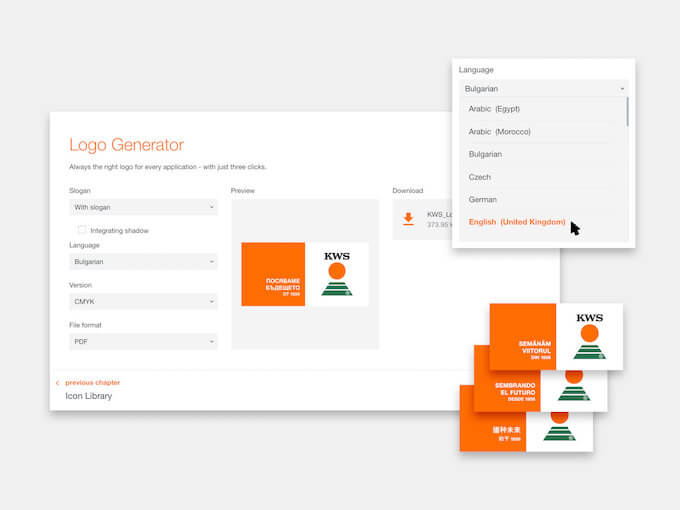
Our system is no longer based on rigid rules. Instead, it is based on a set of core brand elements and guiding principles that can be applied flexibly across a wide range of use cases, always in a way that fits both the medium and the user's needs. For example, instead of providing detailed measurement specifications, we now use short how-to videos. We also introduced a logo generator that produces a specific logo variant—with or without a tagline—depending on what a user needs. This is one of the most frequently used tools because it’s easy to use.
»Make Tools, Not Rules« is one of our core principles, because the more rules you create, the more opportunities there are to make mistakes. You can achieve much more with easy-to-use tools than with endless explanations of what not to do. A good example is our Banner Creator. In the BrandNet, there’s a section that briefly explains how the layout principle for banners works. In addition, there’s an integrated tool that lets users design online banners and posts themselves. Thanks to an interface with our image database, the visual style stays on brand, and because the generator’s layout principles are firmly embedded in the system, it's virtually impossible to create an off-brand design. The result is consistent, on-brand communication—without relying on an agency or requiring in-depth knowledge of the corporate design. Our teams use the tool extensively.
»MAKE TOOLS, NOT RULES is one of our core principles.«
But you don’t have to develop a web tool for every use case, do you!?
Of course not. But that's exactly where it's important to explain the underlying principles—what really matters and what people need to pay attention to. Instead of giving users long lists of things they shouldn't do, why not make it easier for them by providing practical tools and guidance? Our approach: fewer rules, more tools, new incentives, and examples of how to do things better. The key question is always: » Does this actually make someone's job easier? « Take our icon library, for example. Whenever a new icon is added, it’s uploaded to the system as a single file—all other versions are generated by the system on demand in the correct size, color, and file format. This also works with other graphics or illustrations. n the past, we would have had to provide separate files for every possible use case, leaving users to search through countless versions to find the right one. We had a similar issue with our brand colors. Previously, the colors were available only as images, so users had to type in the color value manually. That was prone to errors. With our current interactive color chart, the color values are copied directly to the clipboard with a single click. There’s no longer any chance of making a mistake.
»Why go to great lengthstelling people what not to do?«
How do you prepare your teams for this new way of working?
We see inspiration as a key part of the solution. Since KWS BrandNet is the brand’s first point of contact, it should be inspiring and stimulating. Our goal is to show users what's possible—and wherever we can, we illustrate those possibilities with real-world examples. That’s why we make both new and existing campaigns available as a sources of inspiration—complete with templates and tools. This allows everyone to try things out for themselves immediately when creating their own content.
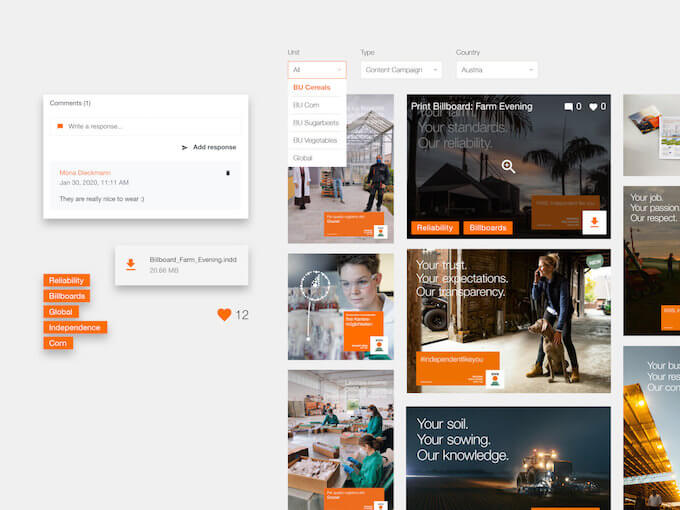
We also foster motivation through activation—via newsletters, webinars, and training sessions. We’ve transformed what used to be complex and lengthy PowerPoint presentations into engaging and interactive content within KWS BrandNet. Take, for example, our web-based and responsive CD training, which is primarily used for onboarding new colleagues. It explains the fundamentals of brand recognition and corporate design—what matters, why it matters, and how it helps create a consistent brand experience. After all, not everyone new to the team is a designer. That’s why we start with specific topics—using plenty of animation and minimal text. These training sessions can be delivered as guided presentations or completed independently. Users can also navigate to specific topics via a menu. Moving away from traditional PowerPoint presentations and embracing a web-based training format certainly required a change in mindset. Today, however, it's become such a natural part of how we work that we're using the same approach for other training programs —for example, on sales. As a result, other departments are now approaching us to host their content on the BrandNet—rather than on SharePoint or Teams.The feedback has been consistently positive.
»We use inspiration as an opportunity. Some of our best ideas for new tools come directly from our employees.«
How important is employee feedback?
Feedback from our colleagues is absolutely essential. Whenever we introduce something new, we ask for feedback on its value, usability, and where it could be improved. We use survey tools like Qualtrics and Slido for this. We track usage statistics with Google Analytics. And wherever problems arise, we dive right in to look for ways to optimize the process. We also encourage everyone to upload new projects, campaigns, and content to inspire other colleagues. Of course, there can still be some hesitation. The question »Did I do this correctly?« still lingers. We try to address this by actively promoting the KWS BrandNet. Of course, we also draw inspiration from the suggestions and requests of our colleagues. Some of our best ideas for new tools come directly from our employees. One example: With the shift to remote work, video meetings became increasingly important. Not everyone wanted to appear in their home environment with a flowerpot or bookshelf in the background, so there was a growing demand for a background that could be quickly added. Our solution was a Background Generator that lets users quickly create customized, on-brand backgrounds. It was a huge hit. Examples like this are exactly what make people say, »This is a portal for us.« People recognize their own needs reflected in it, rely on it in their day-to-day work, and continue to shape its evolution. That’s incredibly motivating.
Thank you very much for the interview!
Would you like to discuss this topic further? Get in touch!
Susanne van Dyk
Business Development