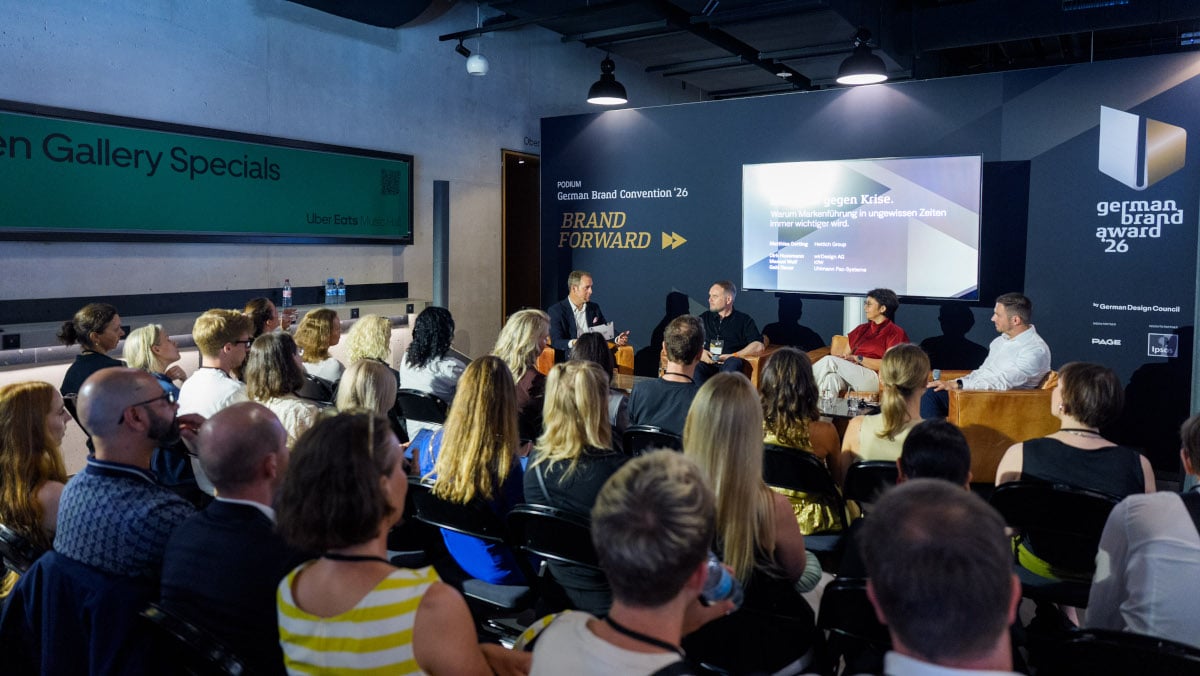
Why strong brands provide guidance, especially in uncertain times: wirDesign CEO Dirk Huesmann discussed the relationship between strategy, leadership, and branding with representatives from Hettich, KfW, and Uhlmann Pac-Systeme at the German Brand Convention.
Economic stagnation, geopolitical conflicts, technological disruption, and growing uncertainty across companies and society– today's environment is defined by constant change rather than stability. As organizations face increasing pressure on investments and long-term decision-making, brand-building is often one of the first areas to be questioned. Yet a crisis is not an argument against investing in brands, but rather one of the strongest arguments for it.
That was the central theme of the panel discussion »Why Brand Management Matters More Than Ever in Uncertain Times« at the German Brand Convention. wirDesign CEO Dirk Huesmann participated in the discussion alongside Gabi Bauer, Director Strategic Sales & Marketing at Uhlmann Pac-Systeme, and Manuel Wolf, Head of Strategy and Brand in Corporate Communications at KfW Bank. The talk was moderated by Matthias Oetting, Director of Marketing at the Hettich Group. The German Brand Convention took place on June 25, 2026, as part of the German Brand Awards under the theme #brandforward. It was a fitting setting for a question that many companies are currently grappling with: How does a brand remain relevant when markets, technologies, and expectations are constantly in flux?
Clarity begins with a clear mission
The panelists were unanimous in their view: Strong brands prove their worth especially in difficult times. They are defined by clarity, conviction, and the ability to continuously evolve.
For Dirk Huesmann, this clarity begins with a fundamental question: »What problem are we here to solve?«
Only when a company can answer this question clearly does the brand become an effective strategic tool—externally, by creating differentiation in the marketplace, and internally, by providing direction for employees and leaders alike. Because in times of great uncertainty, it’s not enough to define a brand primarily by how it differs from the competition. What matters is building a shared understanding of the value the organization creates, the problems it is uniquely positioned to solve, and the role it intends to play—today and in the future.
»If I know that my brand stands for something and that we will solve certain problems in the future, then perhaps that is exactly what we need today,« says Huesmann. Thus a brand doesn’t just guide communication. It provides a framework for decision-making, innovation, and entrepreneurial action.
Strategy and brand must evolve together
Brand strategy must not be viewed in isolation from corporate strategy, products, or the organization itself. The traditional approach of developing a brand strategy and applying it largely unchanged for years no longer meets today’s challenges. Companies must continuously align their strategy, offerings, and brand . Market shifts, emerging technologies, and changing societal expectations can’t simply be translated into communications after the fact. They need to inform strategic decisions from the outset.
A brand doesn't merely follow strategy—it can actively shape it and ac as a catalyst for business evolution It can itself provide important impetus for the company’s further development. That’s why strategy, leadership, and branding are inextricably linked.
Don't Return to the Old Normal—Move Toward What's Next
Huesmann also argued that the commonly used concept of resilience no longer goes far enough. Resilience usually describes the ability to return to a previous state after a crisis. But in many cases, that previous state no longer exists.
»There is no going back—we're moving toward what's next,« Huesmann said during the panel . Companies must therefore not only become more resilient, but also more forward-looking, adaptable, and innovative. The same is true for their brands. Strong brands create confidence without becoming rigid. They must have a clear core while remaining open to change. And they help organizations balance two critical priorities: strengthening today's business while creating tomorrow's opportunities. This ability to combine stability and change is becoming an essential prerequisite for future viability.
Brand strength comes from consistency
The panel also made one thing clear: building a strong brand is not about reacting to every short-term challenge. A brand’s stance and profile are not shaped by individual campaigns, but by consistent action over an extended period of time.
Products, services, communication, and behavior must consistently demonstrate the brand promise. It is precisely during difficult times, therefore, that it becomes clear whether a brand is truly anchored as a strategic compass within the company—or is merely viewed as a communicative facade.
The panel's conclusion was unanimous: Organizations that respond to uncertainty solely by cutting costs and postponing investments are simply managing the crisis. Those who, on the other hand, invest in their positioning, strategic clarity, and the further development of their brand create the conditions necessary to actively shape their future.
A crisis is therefore not an argument against investing in your brand. It's the clearest reminder of why a strong brand matters in the first place.