


Brand Management Strategy and Techniques
In an era marked by channel proliferation, VUCA, and the AI revolution, brand managers face a multitude of challenges.

This applies to both strategic brand management and operational brand management.
The number of digital touchpoints is growing, and AI tools such as ChatGPT, Claude, and Perplexity have introduced entirely new types of brand experiences. While this offers new and exciting opportunities for digital brand communication, it does not make consistent branding any easier.
Without an appropriate brand management system, modern brand management in the digital age is no longer conceivable. And this, in turn, creates new demands on the team, processes, and collaboration with external service providers—as well as on the use of AI tools that can support brand consistency but also jeopardize it.
What is brand management? And why is strategic brand management so important in the first place?
Simply put, the goal of brand management is to anchor the brand in the minds of the target audience in such a way that it clearly stands out from the competition. This success translates into stronger purchase intent, greater customer loyalty, and increased investor confidence. In short, well-managed brands create lasting business value.
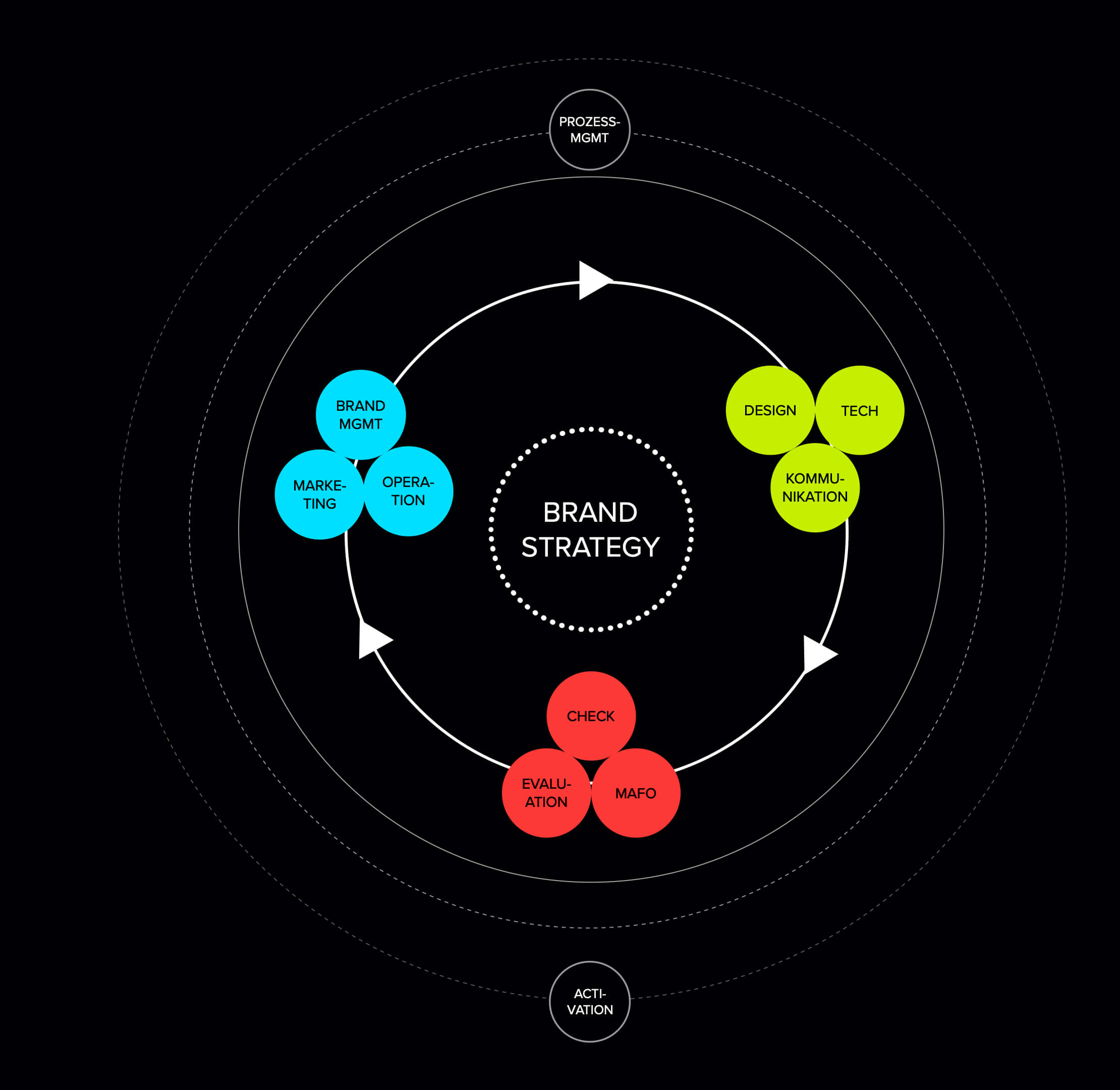
To successfully manage a product or corporate brand, several factors must work together seamlessly. This involves the optimal ideation, implementation, and integration of
-
Brand Strategy
-
Design
-
Communication
-
Technology (digital experience)
-
Management (coordination, consulting, collaboration)
It is only through the successful interplay of these factors that a brand can deliver strong performance and create value for a company. Brand management refers to the process of building and maintaining a brand throughout its entire lifecycle.
The Strategic Dimension of Modern Brand Management
Anyone who bears strategic responsibility for brand management in a company today must think and act with agility. A successful brand must, on the one hand, be flexible enough to adapt to constant change and, at the same time, be so firmly anchored in its brand identity that it does not become interchangeable.
Successful brand management is therefore a management task that demands foresight and adaptability. The German Brand Monitor 2026 underscores this point: While AI is rapidly accelerating content production, only 35% of companies have integrated generative AI into their brand communication processes —making the issue of brand consistency even more pressing.
AI as a Challenge for Brand Management
Generative AI has dramatically increased the speed of content creation—and with it, the risk that brands will lose their uniqueness. When employees, external partners, and automated systems independently produce text, images, and campaigns, a pressing question arises: Who safeguards the brand?
The key AI challenges in modern brand management are:
- Brand consistency in scaled content production: AI tools generate content at high speed—but without a deep understanding of the brand. Tone, visual language, and values can quickly become diluted.
- Loss of control due to decentralization: The more departments and partners use AI, the more difficult it becomes to centrally ensure quality and brand consistency.
- Authenticity vs. Automation: Brands thrive on personality and attitude. Generically optimized AI outputs can undermine precisely what sets a brand apart.
- AI Training with Brand Knowledge: For AI to operate in line with brand guidelines, brand knowledge must be structured, documented, and made available as the foundation for AI models—a new core task for brand management.
- Trust and Transparency: When customers know (or suspect) that content is AI-generated, brand leadership determines whether trust is maintained or eroded.
Every Brand is a Multichannel Brand
To succeed, brand and marketing leaders need a deep understanding of their target audiences, along with data-driven insights into how every touchpoint contributes to the customer journey. Just as important is the ability to act quickly, make informed decisions, and adapt as conditions change. Achieving this requires the right technology stack — including brand management software and analytics platforms — as well as close collaboration across departments and with external partners such as branding and design agencies.
This is the central challenge of strategic brand management: creating the conditions for effective action while maintaining a clear focus on the four dimensions of brand value—value creation, perception, appreciation, and business value.

Operational Brand Management as an Interface Function
On the operational side of brand leadership, managing a brand across digital channels presents brand management with an ever-growing range of responsibilities. Whereas brand marketing used to focus more on ensuring compliance with rigid rules, today it’s all about curation. Operational brand management has evolved from an administrative function into a process of facilitation and collaboration.
Scalable design systems, flexible digital asset management, and AI-powered marketing tools are essential instruments for modern brand management. It’s important to note that AI only realizes its full potential when it is grounded in a clear brand identity and defined guidelines.
The coordination and management of various systems, as well as serving as the interface between the brand’s internal and external stakeholders, are the primary responsibilities of operational brand managers. In this role, they hold a position that is essential to the company’s success.
WIRHUB
Make Tools. Not Rules.
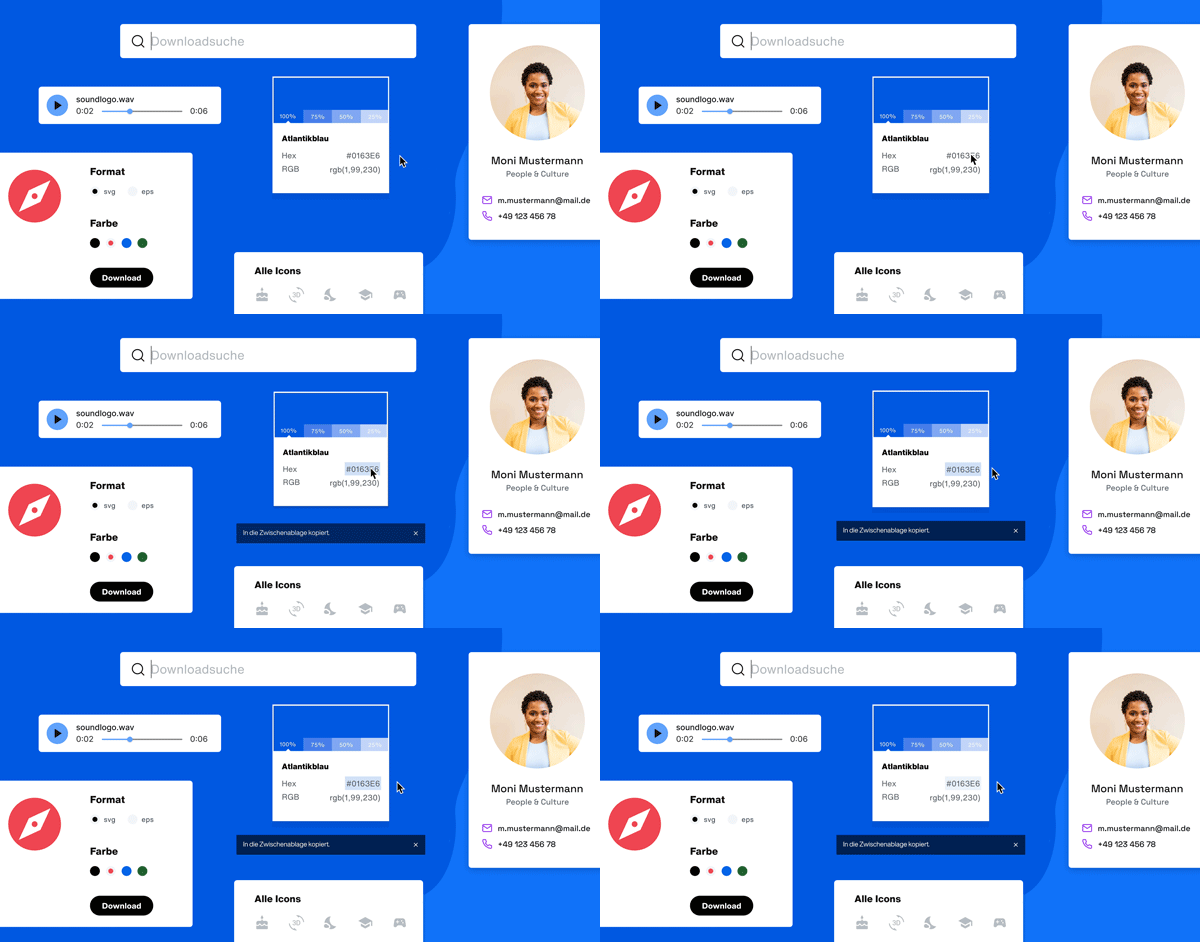
Strong brands need innovative brand management. With wirHub, we’ve implemented an interactive brand portal. The brand management system we developed provides intelligent tools that help designers, sales staff, and marketing managers manage and design communication materials.
Digital Brand Management System
wirHub: The Digital Home of the Brand
Our wirHub is an AI-ready, digital brand management system offered as a »Software as a Service« solution. It includes a wide range of helpful features for managing brands efficiently and effectively.

wirDesign AI
The AI Suite for Brand-Centric Design
With wirDesign AI, we’ve expanded our service portfolio to include an AI-based dimension that takes brand management to the next level—while ensuring that brand values aren’t sacrificed for the sake of speed.

FAQs
Brand management is the strategic and operational management of a brand throughout its entire life cycle —from positioning and corporate design to delivering a consistent customer experience across every touchpoint. The goal is to anchor the brand in the target audience’s consciousness in such a way that it clearly stands out from the competition and builds trust over the long term.
Successful brand management combines five dimensions: brand strategy, design, communication, technology, and brand management. Only when these factors work together does a brand become a measurable source of competitive advantage.
Brand management is important because strong brands have been shown to be more successful economically: According to the 2026 German Brand Monitor, companies with strong brands achieve significantly higher margins and grow more sustainably than companies with weak brand management.
Furthermore, a clearly managed brand provides direction —for customers, employees, and investors. Especially in an era when AI-generated content is flooding digital communication, a distinctive brand identity becomes a decisive differentiator.
Successful brand management consists of six core components:
-
Brand Strategy —positioning, values, and long-term goals
-
Brand Identity – personality, tone, and visual language
-
Corporate Design – consistent design across all media
-
Brand Communication – messages, channels, and campaigns
-
Brand Management System – digital tools and processes for consistency
-
Brand Monitoring – Measuring and managing brand Impact
In the digital age, a seventh component is added: the strategic use of AI tools to support brand consistency — without compromising brand identity.
A successful brand strategy is developed through an analysis of the company, its target audiences, and the competition. Based on this analysis, the brand positioning, brand promise, brand values, and long-term goals are defined. The strategy forms the foundation for all brand management initiatives.
It is important that the brand strategy is not only documented but also actively implemented throughout the entire company. It serves as a guide for communication, design, product development, and corporate culture. This ensures consistent decision-making and a credible brand presence across all touchpoints.
Consistent brand management means that a brand conveys the same values, messages, and design principles at every touchpoint. Whether it’s a website, social media, an annual report, employer communications, or customer service — the brand experience should be consistent across the board.
Clear design and communication guidelines, digital brand portals, and structured brand management all help achieve this. At the same time, brands must remain flexible enough to adapt to new channels, technologies, and target audiences without losing their identity.
Artificial intelligence is fundamentally transforming brand management —presenting both opportunities and risks. According to the German Brand Monitor 2026 , only 35% of companies have integrated generative AI into their brand communication processes, while just 25% systematically incorporate AI into their product and design processes.
AI specifically supports brand management in four areas:
- Content production: texts, images, and campaign ideas are created faster and more cost-effectively
- Personalization: content can be tailored to target audiences based on data
- Brand analysis: AI detects deviations from the brand image across all channels
- Brand management: AI-powered tools like wirDesign AI ensure consistency in decentralized production
At the same time, AI is no substitute for brand strategy. Without clear positioning and guidelines, AI produces generic content — thereby jeopardizing the very thing that makes a brand distinctive.
AI influences brand consistency in two ways: It can strengthen it — or jeopardize it. When employees and partners use AI tools without brand knowledge, the resulting content may not align with the brand identity. This can dilute the brand’s tone, visual language, and values — especially in decentralized, rapid content production.
The solution lies in structured implementation: AI models must be trained using brand knowledge — through brand guidelines, tone guidelines, and visual standards. An AI-enabled brand management system like wirHub ensures that generated content stays within the brand’s guidelines. This way, AI becomes a tool for consistency rather than a threat.
The success of brand management can be measured using qualitative and quantitative metrics. These include, among others, brand awareness, brand perception, brand preference, customer loyalty, willingness to recommend, and trends in revenue or market share.
Digital performance metrics — including reach, engagement, conversion rate, and customer lifetime value — provide valuable insights into a brand's effectiveness. However, no single metric tells the whole story. Only by considering the full range of indicators can organizations understand the long-term contribution of brand management to business success.
Susanne van Dyk
Business Development

Heidi Bohrer
Account Management