

The use of AI services such as ChatGPT, Google AI Overviews, Meta AI, Perplexity and others is creating a new infrastructure for brand perception. One in which brands are part of a conversation that takes place independently of them.
To enable brands to place messages, products and services in AI summaries and conversations in the future, OpenAI will soon be opening up a new possibility with the announcement of ChatGPT Ads: paid ads. They have been tested in the USA since February 9, 2026.
For brands, this means a shift in the rules of the game: Relevance, brand fit and conversation quality will become even more important. For branding agencies, this means a stronger strategic orchestration role.
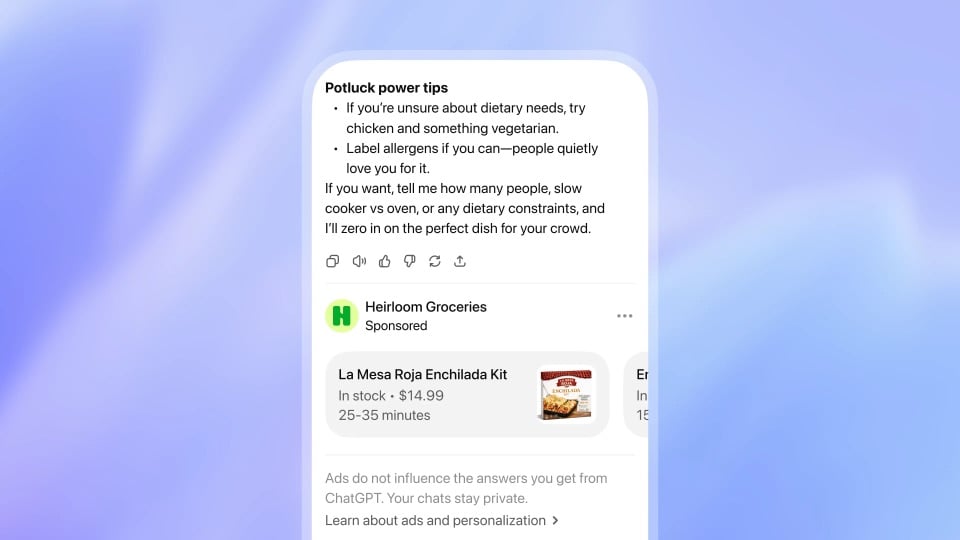
Figure: Paid ads below the response / Source: OpenAI
What could change in concrete terms
OpenAI's announcement to offer advertising in ChatGPT adds a new dimension to marketing. Although OpenAI emphasizes that ads should remain clearly marked and separate from the content of the replies, they will be based on the specific context of the conversation. People planning a trip, for example, could then see hotel or entertainment offers.
In addition to paid access without advertising, OpenAI would like to use this to develop the as yet unprofitable voice model towards profitability. They write: »Our goal is for ads to support broader access to more powerful ChatGPT features [...].« How exactly the advertising model will work remains to be seen. It is very likely that ads will be displayed based on a combination of bid price, relevance, quality and trust signals as well as the context of the conversation.
The fact that this could potentially lead to a loss of trust and quality was recently addressed by competitor Anthropic. It advertises its AI application Claude with the opposite approach: »Ads are coming to AI. But not to Claude.« An exciting battle for the best business model in the AI application sector and an open question as to how the industry will develop.
If AI ads prevail, analysts expect conversational ad formats to take budgets away from traditional search campaigns. Purchase intentions can be addressed more precisely, situationally and interactively. For brands, this means that parts of the performance budget are shifting from search engines to conversational AI environments.
Extended logic for brands
While traditional search ads have long been supported by AI and incorporate search intent, semantic proximity and landing page signals, advertising in ChatGPT is intended to arise directly from the course of the conversation and the situational relevance of the moment. This can reduce wastage, but increases the requirements for semantic fit and brand presence in the right context. Conversational advertising is therefore becoming a growing topic.
Conversational advertising: branding in dialog
Conversational advertising already uses chats, bots or assistants to reach people with personalized recommendations, advice and transactions directly in conversation. Brands that implement this on platforms such as WhatsApp or in messengers report significantly higher engagement rates and noticeably better conversion values.
In generative AI applications, this principle merges with extremely personalized and context-sensitive advice: a problem is addressed or a solution is sought during the conversation - the advertising offer is seamlessly connected in terms of time and content. For example, as an option to test recommended products, book services or deepen content without leaving the conversation.
For brands, this is both an opportunity and a risk: they are no longer »clicked on«, but have to be convincing in dialog. Tonality, usefulness and trustworthiness are becoming the decisive differentiating factors.
What performing brands need now
Brands that want to use AI ads need to define much more clearly what they stand for - and how this identity becomes visible in dialog interfaces: in argumentation logics, semantic guard rails and a consistent, machine-readable brand story. Those who rely exclusively on CI manuals and classic campaign claims are underdefined in purely conversational environments.
At the same time, the demand for responsible targeting is increasing. OpenAI, for example, explicitly excludes ads in sensitive areas such as health, mental health and politics and, according to its own statement, refrains from selling conversation data: »We do not allow advertisers access to your conversations with ChatGPT and never sell your data to advertisers.« Brands must therefore formulate their own data strategies, consent models and brand safety frameworks that convince AI platforms and potential customers alike.
New roles for agencies
Branding agencies are becoming system architects of the brand. They develop, for example:
-
Brand frameworks for AI dialogs
-
Semantic style guides
-
Prompt and response pattern libraries
-
Guard rails for brand safety
Brands are modelled in such a way that AI systems can recognize and play them in a consistent, legally compliant and differentiated manner.
Outlook: the promise and the danger
Ads in dialog can be more relevant than traditional search results. Not because they favor brands, but because they favor good answers. That is the promise.
The danger lies in the extent to which monetization torpedoes precisely this promise. Whether OpenAI, Meta and Co. resist the temptation to rank paid placements higher than objectively better recommendations will be the real test. However, the history of search engines should make us cautiously optimistic here.
One thing is clear, however: we are moving away from an attention economy towards an intention economy. It is not the loudest brand that wins, but the most helpful - with ads and without.
Would you like to discuss this topic further? Get in touch!

Anita Lüder-Bugiel
Corporate Communications